



What Is a Keyword in SEO and How to Choose the Right Ones for Your Website
Every time someone types a question into Google, they are using keywords. But what is a keyword in SEO, and why does choosing the right ones make the difference between a website that ranks on page one and one that nobody ever finds?
In this complete guide, we answer that question in plain language — covering every type of keyword, how to research and choose them, and the exact strategies that work for businesses in Dubai and the UAE in 2025.
| Key Takeaway A keyword in SEO is any word or phrase that people type into Google to find information, products, or services. Choosing the right keywords determines whether your website appears in front of the right audience — or gets lost in search results. The best keyword strategy combines short-tail, long-tail, and LSI keywords matched to your audience’s search intent. |
What Is a Keyword in SEO?
A keyword in SEO is a specific word or phrase that users type into search engines like Google when looking for information, products, or services. For example, someone searching for an SEO company in Dubai might type ‘best SEO agency Dubai’ or ‘how to improve Google rankings in UAE.’
Keywords are the bridge between what people are searching for and the content you create on your website. When your pages are optimised for the right keywords, Google understands what your content is about and shows it to the right people at the right time.
Understanding what is a keyword in SEO is the foundation of every successful SEO campaign. Without the right keywords, even the best content will never reach its intended audience. If you are unsure where to start, a professional seo audit dubai will identify exactly which keywords your website should be targeting based on your industry, competitors, and business goals.
Do Keywords Still Matter in SEO?
This is one of the most common questions business owners ask — and the answer is a clear yes. Keywords absolutely still matter in SEO, but how you use them has evolved significantly.
In the early days of SEO, ranking was largely about repeating keywords as many times as possible — a practice called keyword stuffing. Google’s algorithm has advanced far beyond that. Today, Google understands context, intent, and natural language through its AI systems like BERT and MQL.
However, keywords remain essential because they tell Google what your content is about, help match your pages to the right search queries, signal relevance for specific topics, and guide your content strategy and site structure. The difference in 2025 is that keyword usage must be natural, contextual, and aligned with search intent — not mechanical repetition.
Google’s algorithm evaluates topical authority — meaning it rewards websites that cover a subject comprehensively rather than those targeting isolated keywords. Build keyword clusters around your core topics to establish genuine expertise in your niche.
Types of Keywords in SEO — A Complete Breakdown
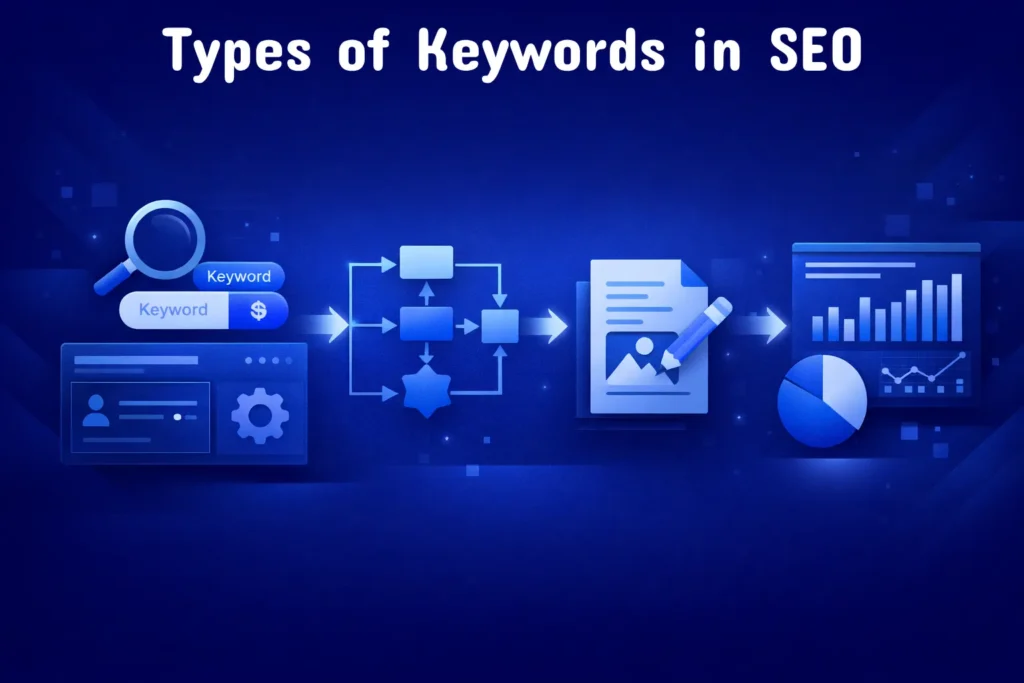
Understanding the different types of keywords in SEO is essential before you can build an effective strategy. Each type serves a different purpose and requires a different approach.
Short-Tail Keywords (Head Keywords)
Short-tail keywords are broad, general terms typically consisting of one to two words. Examples include ‘SEO’, ‘digital marketing’, or ‘real estate Dubai’. They have very high search volumes but are extremely competitive and difficult to rank for, especially for newer websites.
Long-Tail Keywords
What is a long tail keyword in SEO? Long-tail keywords are more specific phrases, typically three to six words long. For example, ‘affordable SEO services for small businesses in Dubai’ is a long-tail keyword. They have lower search volume but significantly higher conversion rates because the searcher’s intent is much clearer.
According to 2024 data, long-tail keywords account for over 70% of all search queries. For most businesses in Dubai, targeting well-chosen long-tail keywords delivers faster results and better ROI than competing for high-volume short-tail terms.
Local Keywords
Local keywords include a geographic modifier — for example, ‘dentist in Business Bay’ or ‘SEO agency JLT Dubai.’ These are essential for businesses serving specific areas. Our local seo services dubai are built around identifying and optimising for the exact local keywords your target customers are searching for in your specific area of Dubai.
LSI Keywords (Latent Semantic Indexing)
LSI keywords in SEO are terms semantically related to your primary keyword. If your main keyword is ‘content marketing’, LSI keywords might include ‘blog writing’, ‘content strategy’, ‘editorial calendar’, and ‘audience engagement’. Google uses these related terms to understand the full context of your content.
Including LSI keywords naturally throughout your content signals to Google that your page covers a topic comprehensively — which improves your chances of ranking for the primary keyword and dozens of related terms simultaneously.
Informational Keywords
Informational keywords are questions or how-to phrases that people use when researching a topic. Examples include ‘what is domain authority’, ‘how does SEO work’, or ‘why is local SEO important’. These keywords are excellent for blog content, guides, and educational articles.
Transactional Keywords
Transactional keywords signal that the searcher is ready to take action — hire, buy, book, or contact. Examples include ‘hire SEO expert Dubai’, ‘SEO agency quote’, or ‘best SEO package UAE’. These are the highest-value keywords for converting traffic into paying customers.
Navigational Keywords
Navigational keywords are brand-specific searches where someone is looking for a specific company or website. For example, ‘SEO Dubai Pro’ or ‘Moz SEO tool’. These are important for brand visibility but less relevant for capturing new audiences.
Negative Keywords
What is negative keywords in SEO? Negative keywords are terms you deliberately exclude from your paid search campaigns to prevent your ads from showing for irrelevant searches. For example, an agency offering premium SEO services might add ‘free’ as a negative keyword to avoid attracting visitors who are not willing to pay for services.
| Keyword Type | Example | Search Volume | Competition |
| Short-tail | SEO Dubai | Very High | Very High |
| Long-tail | best seo agency in dubai for small business | Low | Low |
| Local | seo services business bay dubai | Medium | Medium |
| LSI | search engine optimisation uae | Medium | Medium |
| Informational | what is seo and how does it work | High | Medium |
| Transactional | hire seo expert dubai | Medium | High |
| Navigational | seo dubai pro website | Low | Low |
| Negative | free seo tools (if selling paid services) | High | Excluded |
What Is a Focus Keyword in SEO?
What is a focus keyword in SEO? A focus keyword is the single most important keyword that a specific page is optimised for. Every page on your website should have one primary focus keyword that defines its main topic.
For example, this article’s focus keyword is ‘what is a keyword in SEO.’ Every section, heading, meta tag, and content block on this page is built around that central term.
SEO plugins like RankMath and Yoast SEO ask you to set a focus keyword for each page. This helps ensure your on-page optimisation is aligned with a specific search query — improving your chances of ranking for that term.
Primary Keyword vs Secondary Keyword in SEO
Understanding primary keyword secondary keyword in SEO is essential for creating well-structured content that ranks for multiple terms simultaneously.
Primary Keyword:
The main keyword your page is built around. It appears in the title, H1 heading, first paragraph, and meta description. This page’s primary keyword is ‘what is a keyword in SEO.’
Secondary Keywords:
Supporting keywords that are closely related to your primary keyword. They are used naturally throughout the content in H2 headings, body text, and image alt tags. Secondary keywords help you rank for related searches without creating separate pages.
A well-optimised page typically targets one primary keyword, two to four secondary keywords, and multiple LSI keywords woven naturally throughout the content.
What Is Meta Keywords in SEO — Are They Still Important?
What is meta keywords in SEO? Meta keywords are HTML tags that were once used to tell search engines which keywords a page was targeting. They looked like this in the page’s code: <meta name=’keywords’ content=’SEO, digital marketing, Dubai’>
In 2009, Google officially announced that it no longer uses meta keywords as a ranking signal because they were being abused by spammers. Today, meta keywords have virtually no impact on SEO rankings in Google.
However, meta titles and meta descriptions — which are different from meta keywords — remain critically important. Your meta title and description are what appear in Google search results and significantly influence your click-through rate.
What Is Keyword Gap in SEO?
Keyword gap analysis is the process of identifying keywords that your competitors rank for but your website does not. This gap represents missed opportunities — searches where your competitors are capturing traffic that could be coming to you.
For example, if three of your Dubai competitors rank on page one for ‘SEO services for restaurants Dubai’ but your website does not appear at all, that is a keyword gap. Filling these gaps with targeted content can significantly accelerate your organic growth.
Tools like Ahrefs, Semrush, and Moz all offer keyword gap analysis features. Our team at seo agency dubai conducts keyword gap analysis as part of every client’s initial strategy — ensuring we target the most valuable opportunities your competitors have already validated.
How to Put SEO Keywords in WordPress
How to put seo keywords in wordpress is one of the most practical questions beginners ask. Here is a step-by-step guide:
1. Install RankMath or Yoast SEO plugin — These free plugins guide you through on-page keyword optimisation for every page and post.
2. Set your focus keyword — In the plugin panel, enter your primary keyword. The plugin will then check whether your content is properly optimised.
3. Include the keyword in your page title — Your H1 heading should contain the primary keyword, ideally near the beginning.
4. Use the keyword in the first 100 words — Google gives extra weight to keywords that appear early in the content.
5. Add the keyword to your meta title and meta description — These appear in Google search results and influence click-through rates.
6. Use the keyword in at least one H2 subheading — Subheadings help Google understand your page structure.
7. Include the keyword in image alt text — Describe your images using the keyword where it fits naturally.
8. Use the keyword naturally throughout the content — Aim for a keyword density of 1 to 2% — do not force it.
Monitoring your keyword performance after publishing is equally important. Our google search console service dubai helps you track exactly which keywords are driving impressions and clicks to your pages — giving you the data to refine your keyword strategy over time.
Keyword Placement in SEO — Where Keywords Actually Matter
Keyword placement in SEO is as important as keyword selection. Placing keywords in the right locations signals relevance to Google without tipping into keyword stuffing.
● Page Title (H1): Most important placement. Include the primary keyword as close to the beginning as possible.
● Meta Title and Description: These appear directly in Google search results and influence whether people click on your listing.
● First Paragraph: Include the primary keyword within the first 100 words of your content.
● H2 and H3 Subheadings: Use primary and secondary keywords in subheadings to reinforce topic relevance.
● URL Slug: Keep URLs short and include the primary keyword. Example: /what-is-a-keyword-in-seo/
● Image Alt Text: Describe images using relevant keywords to help Google understand your visual content.
● Internal Link Anchor Text: When linking to other pages on your site, use descriptive keyword-rich anchor text.
Keyword Tracking in SEO — How to Monitor Your Rankings
Keyword tracking in SEO is the process of monitoring where your website ranks for specific keywords over time. Without tracking, you have no way of knowing whether your SEO efforts are working or which pages need improvement.
What is keyword position in SEO? Keyword position refers to where your page appears in Google’s search results for a specific keyword. Position 1 is the top result, position 10 is the last result on page one, and anything beyond position 10 is on page two or lower.
● Positions 1–3: Receive the vast majority of clicks. Position 1 gets approximately 27–45% of all clicks for a given query.
● Positions 4–10: Receive significantly fewer clicks but still generate meaningful traffic.
● Positions 11+: Receive minimal traffic. Pages in these positions need improvement to move to page one.
Use tools like Google Search Console, Ahrefs, Semrush, or Moz to track keyword positions weekly. Set up rank tracking for your top 20 to 50 priority keywords and monitor changes after every content update or link building campaign.
Best Practices for Keyword Strategies in SEO — 2025 Edition
Following best practices for keyword strategies in SEO ensures your efforts align with how Google actually works today — not how it worked five years ago.
1. Focus on search intent first — Before targeting any keyword, understand why someone is searching for it. Are they looking for information, a product, or a service? Your content must match that intent.
2. Build keyword clusters — Instead of targeting isolated keywords, group related terms into topic clusters. Create one comprehensive pillar page and multiple supporting pages that link back to it.
3. Target quick wins alongside long-term keywords — Mix keywords where you can rank quickly (low competition, relevant to your DA) with aspirational high-competition terms you are working toward.
4. Use semantic keywords naturally — Include LSI keywords and related terms throughout your content to help Google understand the full context of your page.
5. Update and refresh existing content — Regularly review your ranking pages and update them with new keywords, fresher data, and improved content. Google rewards consistently updated pages.
6. Do not ignore negative keywords — In Google Ads campaigns, negative keywords prevent wasted spend. Even in organic SEO, understanding which terms are not relevant to your audience shapes better content decisions.
7. Track and adapt — Keyword performance changes over time. Monitor rankings monthly and adjust your strategy based on what is working and what is not.
Expert Insight: Keyword Strategy in the Dubai Market
Expert Insight — 10 Years of Keyword Strategy in UAE
After conducting keyword research for hundreds of Dubai businesses across real estate, healthcare, legal, and e-commerce sectors, I have learned one consistent truth: the businesses that win in organic search are almost never the ones targeting the most popular keywords. They are the ones who identify specific, high-intent long-tail keywords that their competitors have overlooked — and create genuinely helpful content around those terms. In Dubai’s multilingual market, Arabic and English keyword research is equally important. Many businesses leave enormous traffic opportunities untapped simply because they only research keywords in English.
Real Case Study: How Keyword Strategy Transformed a Dubai Law Firm’s Traffic
A Dubai law firm approached us with a website that had been online for four years but received fewer than 200 organic visits per month. Their content was generic and targeted only two broad keywords: ‘lawyer Dubai’ and ‘legal services UAE’ — both extremely competitive terms dominated by large firms with DA scores above 50.
Here is the keyword strategy we implemented over 12 months:
1. Conducted a full keyword gap analysis identifying 340 long-tail keywords their competitors ranked for but they did not.
2. Identified 45 high-intent, low-competition keywords with monthly search volumes between 100 and 800 — realistic to rank for within 6 months.
3. Created 28 targeted service and blog pages around these keyword clusters.
4. Optimised all existing pages with proper keyword placement in titles, headings, meta descriptions, and body content.
5. Built local keyword targeting for specific practice areas: ’employment lawyer business bay’, ‘visa dispute lawyer dubai’, ‘commercial contract lawyer DIFC’.
Results after 12 months: Organic traffic grew from 200 to 4,800 visits per month — a 2,300% increase. The firm ranked on page one for 67 keywords. Monthly qualified enquiries from organic search increased from 3 to 42. Revenue attributed to organic search grew by AED 380,000 annually.
Keep Learning: Build Your Complete SEO Foundation
Keywords are just one piece of the SEO puzzle. To build a complete understanding, explore these essential resources from our SEO Basics series:
● Why SEO is Important — Understand why organic search is the most valuable long-term marketing channel for your business.
● What is SEO and How Does It Work — A complete beginner’s guide to search engine optimisation.
● What is Domain Authority — Learn how website authority affects your ability to rank for competitive keywords.
● How Long Does SEO Take to Show Results — Set realistic expectations for your keyword ranking timeline.
● On Page vs Off Page SEO — Understand the two pillars of SEO and how they work together to improve keyword rankings.
Conclusion: Master Keywords to Master Your SEO
Understanding what is a keyword in SEO is not just an academic exercise — it is the practical foundation of every successful digital marketing strategy. The right keywords connect your business to the people who are actively searching for exactly what you offer.
In Dubai’s competitive digital landscape, keyword strategy requires more than picking popular terms. It requires understanding search intent, identifying opportunities your competitors have missed, and creating content that genuinely answers what your audience is looking for.
Whether you are optimizing your first WordPress page or rebuilding a comprehensive content strategy from scratch, the principles remain the same: research thoroughly, choose strategically, optimise naturally, track consistently, and adapt continuously.
Need help building a keyword strategy that actually drives results for your Dubai business? Our team at seo agency dubai specialises in data-driven keyword research and content strategies tailored to the UAE market. Start with a free consultation today and discover which keywords will move the needle for your business.
Frequently Asked Questions — What Is a Keyword in SEO
What is a keyword in SEO in simple terms?
A keyword in SEO is any word or phrase that someone types into Google when searching for information. For example, ‘best coffee shop in Dubai Marina’ is a keyword. SEO involves optimising your website to appear in Google’s results when people search for keywords related to your business.
How important are keywords in SEO?
Keywords are the foundation of SEO. They tell Google what your content is about and help match your pages to the right search queries. Without proper keyword research and optimisation, your content may never reach the people who are actively searching for what you offer.
Are keywords still relevant in SEO in 2025?
Yes, absolutely. Keywords remain essential in 2025, but the approach has evolved. Google now focuses on search intent and topical relevance rather than keyword density. Use keywords naturally and contextually, and focus on covering topics comprehensively rather than repeating exact phrases mechanically.
What is a long tail keyword in SEO?
A long-tail keyword is a specific, multi-word phrase that targets a narrower audience. For example, ‘affordable SEO for restaurants in JBR Dubai’ is a long-tail keyword. These keywords have lower search volume but much higher conversion rates because they match very specific search intent.
What is a focus keyword in SEO?
A focus keyword is the single primary keyword that a specific page is optimised for. It is the term you most want your page to rank for. SEO plugins like RankMath and Yoast SEO use the focus keyword to evaluate whether your page is properly optimised.
What is meta keywords in SEO?
Meta keywords are HTML tags that were historically used to list target keywords for a page. Google stopped using them as a ranking factor in 2009. Today, they have no impact on Google rankings. Focus instead on your meta title and meta description, which directly influence click-through rates from search results.
What is keyword gap in SEO?
Keyword gap is the difference between the keywords your competitors rank for and the keywords your website does not. Identifying and filling keyword gaps helps you capture traffic that your competitors are already benefiting from. Tools like Ahrefs and Semrush offer keyword gap analysis features.
What is keyword position in SEO?
Keyword position refers to where your page appears in Google’s search results for a specific keyword. Position 1 is the top result. The goal of SEO is to move your pages into the top 3 positions for your target keywords, as these positions receive the vast majority of clicks.
What is keyword tracking in SEO?
Keyword tracking is the process of monitoring your website’s rankings for specific keywords over time. By tracking keyword positions weekly or monthly, you can identify which pages are improving, which need work, and how your overall SEO strategy is performing.
What is negative keywords in SEO?
Negative keywords are search terms you deliberately exclude from paid search campaigns to prevent irrelevant traffic. For example, a premium law firm might exclude ‘free legal advice’ as a negative keyword. While primarily a Google Ads concept, understanding negative keywords helps you refine both paid and organic content strategies.
What are LSI keywords in SEO?
LSI (Latent Semantic Indexing) keywords are terms semantically related to your primary keyword. They help Google understand the full context of your content. For a page about ‘SEO services Dubai’, LSI keywords might include ‘Google rankings UAE’, ‘organic traffic Dubai’, and ‘search engine optimisation UAE’.
How to find the right keywords for my Dubai business?
Start with Google’s autocomplete feature to discover what real people are searching for. Use tools like Google Keyword Planner, Ahrefs, or Semrush for volume and competition data. Analyse your competitors’ keyword rankings for gap opportunities. Finally, work with a professional seo agency dubai to build a comprehensive keyword strategy tailored to your specific industry and target audience in the UAE.
How many keywords should I target per page?
Each page should have one primary keyword, two to four secondary keywords, and multiple LSI keywords woven naturally throughout the content. Targeting too many keywords on a single page dilutes your relevance signals. It is far more effective to create separate, dedicated pages for different keyword clusters.
What is the importance of semantic keywords in SEO?
Semantic keywords signal to Google that your content covers a topic comprehensively. Google’s algorithm uses semantic analysis to understand content beyond exact keyword matches. Including semantically related terms helps your page rank for the primary keyword and dozens of related searches simultaneously — expanding your organic reach without creating additional pages.
How do I check which keywords my website currently ranks for?
Google Search Console is the most reliable free tool for checking which keywords your website ranks for. It shows your average position, impressions, and clicks for every keyword driving traffic to your site. Our google search console service dubai sets up and optimises your Search Console account so you have full visibility into your keyword performance from day one.

1 Comment
How to Increase Organic Traffic — SEO Expert Guide
March 29, 2026 at 10:20 am[…] identify keywords with the right balance of search volume and competition. Understand our guide on What Is a Keyword in SEO to build a solid keyword foundation before creating any […]