



| Key Takeaway Technical SEO is the process of optimising the infrastructure of your website so that search engines can efficiently crawl, index, and rank your pages. It covers page speed, mobile-friendliness, crawlability, site architecture, schema markup, HTTPS security, and Core Web Vitals. Without a technically sound foundation, even the best content and strongest backlinks cannot deliver the rankings your business deserves. |
You have written excellent content. You have earned quality backlinks. You have done your keyword research. Yet your website still is not ranking the way it should. Sound familiar? In the vast majority of cases when this happens, the culprit is technical SEO — or rather, the lack of it.
Understanding what is technical SEO is one of the most impactful investments any business owner or marketer can make. It is the invisible foundation beneath every successful SEO campaign — and when it is broken, everything else suffers. This guide explains technical SEO in plain language, covers every key element, and shows you exactly how to identify and fix the issues that are holding your website back.
What Is Technical SEO?
Technical SEO is the branch of search engine optimisation focused on improving the technical aspects of a website — the code, structure, speed, and architecture — so that search engines can efficiently crawl, understand, and index your pages. While content SEO focuses on what your pages say and off-page SEO focuses on who links to you, technical SEO focuses on how your website is built.
Think of it this way: content SEO gives Google something worth ranking, backlinks tell Google your content is trustworthy, and technical SEO ensures Google can actually find, read, and evaluate what you have created. Without technical SEO, the other two pillars cannot reach their full potential.
For Dubai businesses that have invested in content and links without seeing results, a comprehensive seo audit dubai almost always reveals technical issues that have been quietly suppressing rankings — often for months or years without the business owner realising.
The Three Pillars of SEO — Where Technical SEO Fits
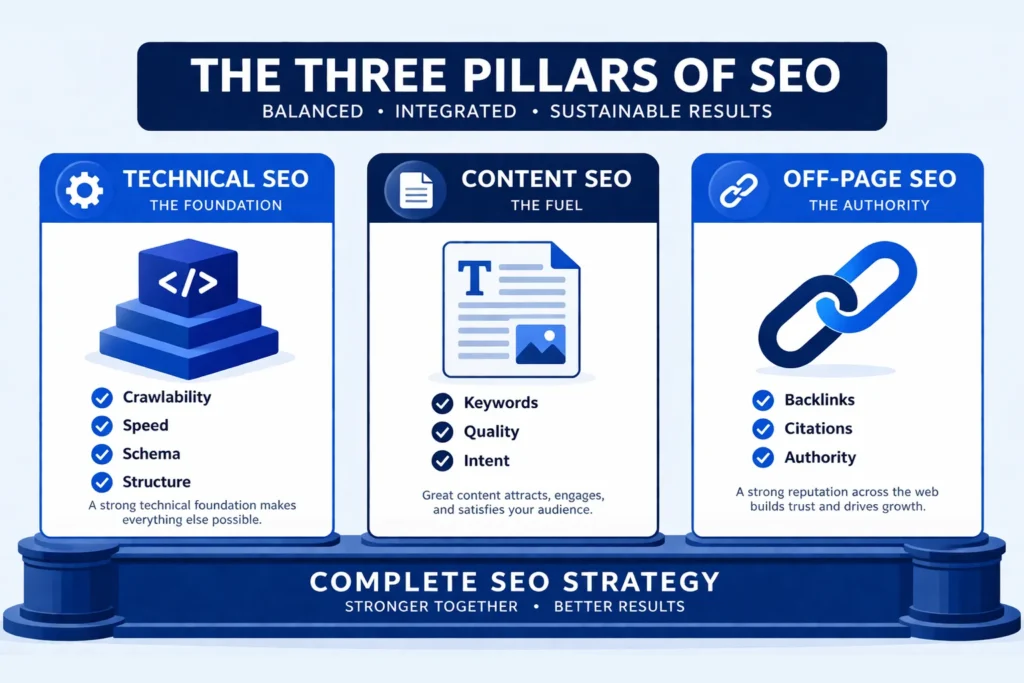
What are the three pillars of SEO? Content, links, and technical SEO — each is essential, and each depends on the others to function effectively.
| SEO Pillar | What It Covers | Primary Goal |
| Technical SEO | Crawlability, indexing, speed, structure, schema | Make site readable for Google |
| Content SEO | Keywords, quality, relevance, intent match | Give Google something worth ranking |
| Off-Page SEO | Backlinks, citations, brand mentions, authority | Build trust and authority externally |
| Relationship | All three must work together | Technical = the foundation both others need |
The most important insight from this table: technical SEO is the foundation. You can publish exceptional content and earn hundreds of high-authority backlinks — but if Google cannot properly crawl and index your website, those investments deliver a fraction of their potential return.
What Is Included in Technical SEO?
What is included in technical SEO covers a broad range of website elements. Here is a comprehensive breakdown of the core areas every technical SEO specialist addresses:
1. Crawlability
Crawlability refers to Google’s ability to discover and access your web pages. Google’s bots (called crawlers or spiders) systematically visit websites and read their content. If your website has crawl blocks — through robots.txt files, noindex tags, or broken internal links — Google cannot access your pages and therefore cannot rank them.
- Robots.txt: A file that tells search engines which pages they can and cannot access. A misconfigured robots.txt is one of the most common causes of sudden ranking loss.
- Crawl Budget: Google allocates a limited number of page crawls to each website. Poor site structure wastes this budget on unimportant pages, leaving valuable pages uncrawled.
- Internal Linking: A well-structured internal linking system helps crawlers discover all important pages efficiently.
2. Indexability
Indexability refers to whether Google actually stores your pages in its index after crawling them. Even if Google can access your pages, various technical issues can prevent them from being indexed — meaning they will never appear in search results.
- Noindex tags — accidentally applied or incorrectly configured.
- Duplicate content — identical or near-identical pages confuse Google about which version to index.
- Canonical tags — incorrect canonicalization causes the wrong page version to be indexed.
- XML sitemap issues — missing, outdated, or error-filled sitemaps slow down indexing.
3. Page Speed and Core Web Vitals
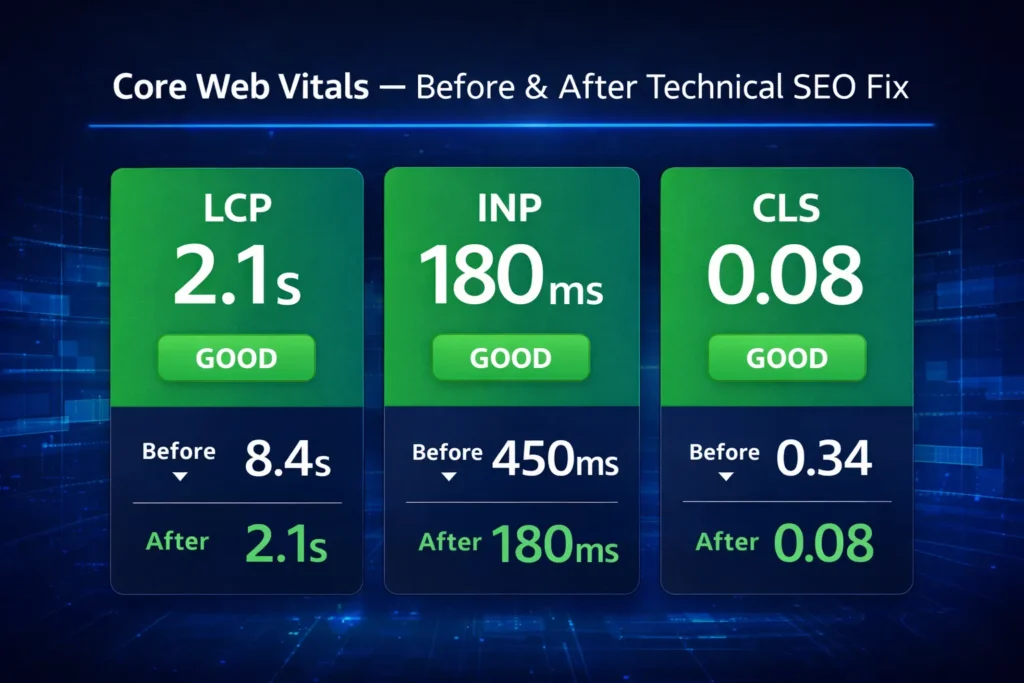
Google uses page experience signals — including loading speed, interactivity, and visual stability — as ranking factors. Core Web Vitals are Google’s specific speed metrics:
- LCP (Largest Contentful Paint): How long it takes for the main content to load. Target: under 2.5 seconds.
- FID / INP (Interaction to Next Paint): How quickly the page responds to user interaction. Target: under 200 milliseconds.
- CLS (Cumulative Layout Shift): How much the page layout shifts as it loads. Target: below 0.1.
Research consistently shows that a one-second delay in page load time reduces conversions by 7%. Slow websites do not just rank lower — they also lose more of the visitors they do attract.
4. Mobile-Friendliness
Google uses mobile-first indexing — meaning it primarily uses the mobile version of your website for ranking and indexing decisions. A website that looks great on desktop but breaks on mobile is actively penalised in Google’s algorithm. With over 70% of searches in the UAE occurring on mobile devices, mobile technical SEO is not optional.
5. HTTPS and Website Security
HTTPS (secure website protocol) is a confirmed Google ranking signal. Websites without a valid SSL certificate — showing as ‘Not Secure’ in browsers — are at a ranking disadvantage and lose customer trust immediately. Every page on your website must load securely via HTTPS with no mixed content errors.
6. Site Architecture and URL Structure
A logical, clean site architecture helps both users and search engines understand how your website is organised. Flat site architecture (where any page is reachable in 3 clicks or fewer from the homepage), clean URL structures, and proper breadcrumb navigation all contribute to technical SEO strength.
7. Structured Data and Schema Markup
Structured data is code added to your website that helps Google understand your content in a machine-readable format. Properly implemented schema markup can earn rich results in search — star ratings, FAQ dropdowns, product prices, event dates — which dramatically increase click-through rates from the same ranking position.
8. Duplicate Content and Canonical Issues
Duplicate content — identical or near-identical content appearing on multiple URLs — confuses Google about which page to rank. Common causes include www vs non-www URLs, HTTP vs HTTPS versions, URL parameters, and pagination. Canonical tags tell Google which version of a page is the ‘master’ version to index and rank.
What Is a Technical SEO Audit?
A technical SEO audit is a systematic examination of your website’s technical health — identifying every issue that prevents search engines from properly crawling, indexing, and ranking your pages. Think of it as a full health check for your website’s infrastructure.
What is a technical audit for an SEO website covers every element from the table above. A comprehensive audit examines: crawl errors and blocked pages, indexing status of all important pages, page speed and Core Web Vitals scores, mobile usability issues, HTTPS and security errors, duplicate content and canonical tag problems, structured data errors, internal linking structure, and XML sitemap health.
| Audit Category | Key Checks | Common Issues Found | Impact If Ignored |
| Crawlability | Robots.txt, crawl budget, internal links | Blocked pages, orphan pages | Pages not indexed |
| Indexing | Sitemap, noindex tags, canonicals | Wrong pages indexed | Ranking wrong pages |
| Page Speed | Core Web Vitals, image size, code | Slow mobile load | Rankings suppressed |
| Mobile UX | Mobile-friendly test, tap targets | Broken mobile layout | Traffic loss |
| HTTPS / Security | SSL cert, mixed content | HTTP pages, expired SSL | Trust signals lost |
| Structured Data | Schema validity, rich results | Schema errors | No rich results |
| Duplicate Content | Canonical tags, thin pages | Duplicate meta, thin content | Ranking dilution |
For Dubai businesses, a professional technical seo service dubai delivers a complete audit across all these categories — identifying every issue and providing a prioritised action plan with specific fixes for each problem found.
How to Perform a Technical SEO Audit — Step by Step
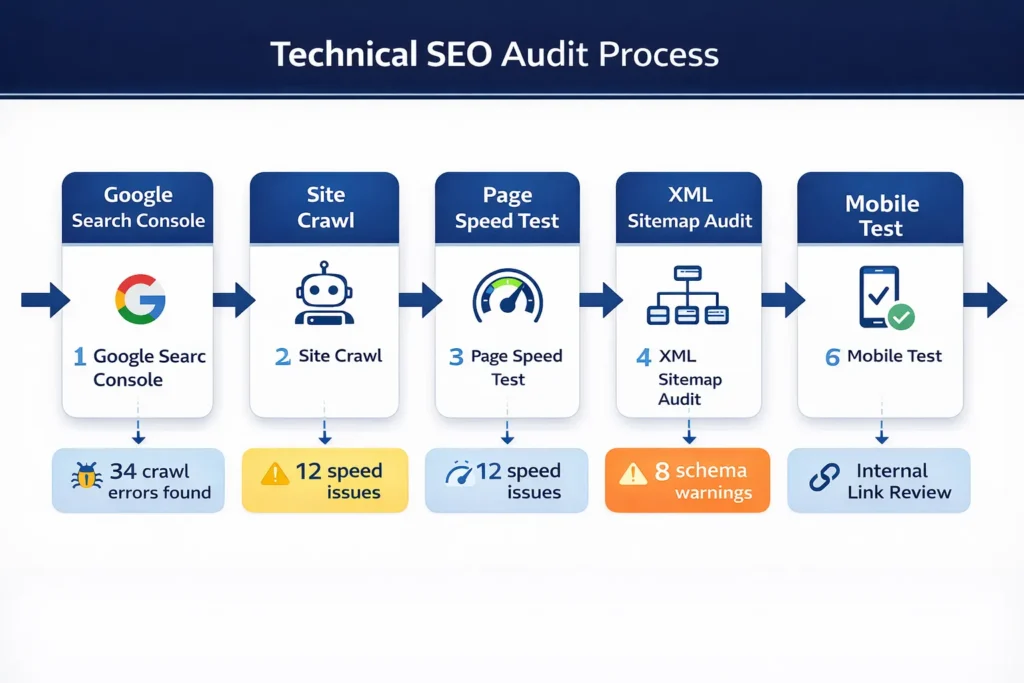
How to perform a technical SEO audit requires the right tools and a systematic approach. Here is the exact process used by technical SEO specialists:
Step 1: Set Up Google Search Console
Google Search Console is the most authoritative source of technical SEO data — it shows you exactly what Google sees when it crawls your website. Set up and verify your Search Console account, then review the Coverage report (indexing errors), Core Web Vitals report, Mobile Usability report, and any Manual Actions. Our google search console service dubai sets up and fully optimises your Search Console account — giving you direct, accurate data on every technical issue Google has identified on your website.
Step 2: Run a Full Site Crawl
Use a crawl tool — Screaming Frog, Ahrefs Site Audit, or Semrush Site Audit — to systematically crawl every page on your website. This replicates what Google’s bots do and reveals: broken links (404 errors), redirect chains, missing meta tags, duplicate title tags, missing alt text, and pages blocked by robots.txt.
Step 3: Check Page Speed
Run your most important pages through Google PageSpeed Insights and GTmetrix. Both tools provide specific, actionable recommendations — image compression, browser caching, code minification, server response time — with each issue scored by its impact on your Core Web Vitals performance.
Step 4: Audit Your XML Sitemap
Your XML sitemap should list all important pages and be free of errors. Check that it is submitted to Search Console, that it does not include pages that return 404 errors or have noindex tags, and that it is automatically updated when new content is published.
Step 5: Check Structured Data
Use Google’s Rich Results Test and Schema Markup Validator to check all structured data implemented on your website. Identify any schema errors, warnings, or missing recommended fields that are preventing you from earning rich results in search.
Step 6: Review Mobile Experience
Test all key pages using Google’s Mobile-Friendly Test. Identify tap targets that are too small, text that is too small to read without zooming, content that is wider than the screen, and any mobile-specific usability errors flagged in Search Console.
Step 7: Audit Internal Linking
Review your website’s internal linking structure to identify orphan pages (pages with no internal links pointing to them), pages with too many inbound internal links (over-optimised), and opportunities to strengthen important pages by adding relevant internal links from other pages on your site.
Pro Tip: When conducting a technical SEO audit, always start with Google Search Console — not a third-party tool. Search Console shows you exactly what Google has actually seen and flagged on your website. Third-party crawl tools are excellent for finding issues Search Console does not report, but the issues Google itself has flagged should always be your first priority to fix.
Technical SEO for Different Business Types
Technical SEO for WordPress
Technical SEO WordPress is the most common implementation environment. WordPress offers significant advantages — plugins like RankMath, Yoast SEO, and WP Rocket handle many technical SEO elements automatically. However, WordPress also introduces common technical issues: slow page speed from excessive plugins, bloated theme code, incorrect permalink structures, and duplicate content from category and tag pages. A technical SEO specialist for WordPress focuses on: selecting a lightweight, well-coded theme, optimising the plugin stack, configuring caching and image compression, and cleaning up URL structure.
Technical SEO for B2B Websites
What is technical SEO important for B2B websites specifically? B2B websites typically have complex site architectures — multiple product categories, industry-specific pages, resource libraries, and gated content. Technical SEO for B2B ensures that Google can crawl all publicly relevant pages, that gated content is properly handled to avoid indexing issues, that site speed supports the longer research sessions typical of B2B buyers, and that structured data correctly represents products, services, and company information.
Technical SEO for Hotels
What is technical SEO for hotels involves unique challenges: multi-location pages, dynamic pricing content, booking system integration, multilingual content for international guests, and rich media (photos, virtual tours) that must be properly optimised for speed. Hotel technical SEO also includes structured data for hotel-specific schema types, which help Google display room prices, availability, and ratings directly in search results.
Technical SEO for SaaS
SaaS technical SEO addresses the specific technical challenges of software-as-a-service websites: dynamic content that may not be crawlable by Google, JavaScript rendering issues that hide content from search engines, user-generated content indexation decisions, subdomain vs subdirectory strategy for blog and help content, and handling authenticated content that should not be indexed.
How to Choose the Right Technical SEO Agency
How to choose the right technical SEO agency is a critical decision — the wrong choice can waste months of time and budget while technical issues quietly suppress your rankings.
- Proven audit process: Ask to see a sample technical audit. A quality audit should identify specific issues with specific locations in your code — not generic recommendations that apply to any website.
- Tool transparency: A credible technical SEO expert uses and references industry-standard tools — Screaming Frog, Google Search Console, Ahrefs, PageSpeed Insights. Be sceptical of any agency that cannot name the tools they use.
- Implementation capability: Identifying issues is only half the work. The agency must also be able to fix them — either directly or in close collaboration with your development team.
- Clear reporting: Monthly technical SEO reporting should show specific metrics — crawl errors resolved, Core Web Vitals scores, indexed pages count — not just vague statements about ‘improvements’.
- Industry experience: Technical SEO challenges vary significantly by industry and platform. An agency with experience in your specific sector and CMS will deliver faster, more accurate results.
Expert Insight: Technical SEO in the UAE Market
Expert Insight — 10 Years of Technical SEO Audits for UAE Businesses
After conducting technical SEO audits for hundreds of UAE businesses across e-commerce, real estate, healthcare, legal, and hospitality sectors, I have identified three issues that appear in nearly every audit — regardless of business size or industry. First: accidental noindex tags on important pages. This happens most often after website migrations or CMS updates, and it can cause a business to lose rankings overnight without any obvious external cause. Second: poor Core Web Vitals on mobile — particularly slow LCP caused by uncompressed hero images. In a market where over 70% of searches occur on mobile devices, this is a ranking penalty hiding in plain sight. Third: incorrect or missing canonical tags on paginated content, creating dozens or hundreds of near-duplicate pages that dilute ranking authority. The businesses that fix these three issues consistently — and quickly — see the most dramatic improvements from technical SEO work.
Real Case Study: How Technical SEO Fixes Tripled Organic Traffic for a Dubai E-Commerce Business
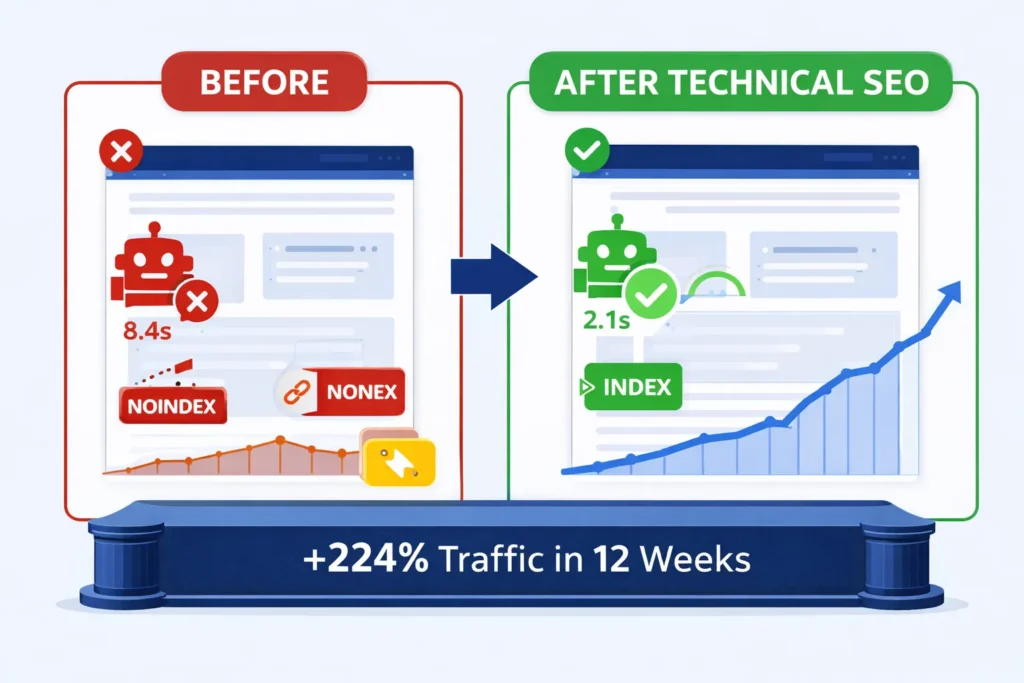
A Dubai-based online furniture retailer came to us after six months of flat organic traffic despite publishing regular blog content and earning backlinks. Their monthly organic visitors had plateaued at 2,100 despite significant content investment. A comprehensive technical SEO audit revealed the following critical issues:
- Their robots.txt file was inadvertently blocking Google from crawling all product category pages — the highest-value pages on the site.
- 282 product pages had noindex tags applied from a previous site migration that had never been removed.
- Their mobile page speed score was 31 out of 100, with an LCP of 8.4 seconds due to uncompressed product images.
- 47 pages had duplicate title tags — confusing Google about which page to rank for relevant queries.
- No structured data was implemented — missing Product schema, Review schema, and Breadcrumb schema.
Here is the technical remediation we executed over 8 weeks:
- Fixed robots.txt to allow crawling of all category and product pages.
- Removed noindex tags from all 282 product pages and resubmitted the corrected sitemap to Search Console.
- Compressed all product images, implemented next-gen image formats (WebP), and enabled browser caching — reducing mobile LCP from 8.4 seconds to 2.1 seconds.
- Rewrote all duplicate title tags with unique, keyword-relevant titles for each page.
- Implemented Product, Review, Breadcrumb, and Organisation schema markup across all relevant pages.
Results after 12 weeks: Organic traffic grew from 2,100 to 6,800 monthly visitors — a 224% increase — without publishing a single new piece of content or building a single new backlink. Simply making existing content accessible and readable to Google produced results that months of content investment had failed to generate. Revenue from organic search grew by AED 340,000 annually.
Related Guides to Build Your Complete SEO Foundation
Technical SEO works best as part of a comprehensive SEO strategy. These guides provide the complete picture:
- What is Local SEO — How technical SEO supports local search visibility for businesses serving specific geographic areas.
- How Long Does SEO Take to Show Results? — Set realistic timelines for technical SEO improvements and what to expect from each type of fix.
Frequently Asked Questions — What Is Technical SEO
What is technical SEO in simple terms?
Technical SEO is the process of making your website easier for Google to find, read, and rank. It covers the behind-the-scenes elements of your website — page speed, mobile-friendliness, security, site structure, and structured data — that determine whether Google can properly access and evaluate your content. Think of it as the foundation your entire SEO strategy is built upon.
What is a technical SEO audit?
A technical SEO audit is a systematic examination of your website’s technical health. It identifies every issue preventing Google from properly crawling, indexing, and ranking your pages — including crawl errors, slow page speed, mobile usability problems, duplicate content, missing schema markup, and security issues. A quality audit provides specific issues, their locations on your website, and prioritised recommendations for fixing them.
How to conduct a technical SEO site audit step by step?
The key steps are: (1) Review Google Search Console for all flagged errors, coverage issues, and Core Web Vitals warnings. (2) Run a full site crawl using Screaming Frog or Ahrefs to identify broken links, duplicate content, and missing meta tags. (3) Test page speed using PageSpeed Insights. (4) Check mobile-friendliness using Google’s Mobile-Friendly Test. (5) Validate structured data using Google’s Rich Results Test. (6) Review your XML sitemap for errors.
What is included in technical SEO?
Technical SEO includes: crawlability (ensuring Google can access all important pages), indexability (ensuring the right pages appear in Google’s index), page speed and Core Web Vitals, mobile-friendliness, HTTPS security, site architecture and URL structure, XML sitemaps, robots.txt configuration, canonical tags, structured data and schema markup, duplicate content resolution, and internal linking optimisation.
What are the three pillars of SEO — content, links, and technical?
The three pillars of SEO are: Content SEO (creating high-quality, keyword-relevant content that matches search intent), Off-Page SEO (earning backlinks and brand mentions that build authority), and Technical SEO (ensuring your website infrastructure allows Google to properly crawl, index, and rank your content). All three must work together — technical SEO is the foundation that enables the other two pillars to reach their full ranking potential.
What do business owners need to know about technical SEO?
Business owners need to understand three key things about technical SEO: (1) It is not optional — even the best content will not rank if Google cannot properly access your website. (2) Issues accumulate invisibly — most technical SEO problems develop gradually and are not apparent from looking at your website in a browser. (3) Fixing technical issues can produce faster ranking improvements than any other SEO activity — as demonstrated by case studies where fixing crawl issues tripled traffic without creating any new content.
How much does a full technical SEO audit cost?
Technical SEO audit costs vary based on website size and complexity. For a small to medium UAE business website (under 500 pages), a comprehensive technical SEO audit typically costs AED 1,500 to AED 5,000. For larger e-commerce or enterprise websites with thousands of pages, costs can range from AED 5,000 to AED 20,000 or more. The ROI of identifying and fixing critical technical issues almost always significantly exceeds the audit cost within the first 3 to 6 months.
What is technical SEO for hotels specifically?
Technical SEO for hotels addresses unique challenges including: multi-location page management, dynamic pricing content that changes frequently, booking system integration that must not create duplicate or thin content, multilingual content for international guests, rich media optimisation for photos and virtual tours, and hotel-specific schema markup (HotelRoom, LodgingBusiness) that helps Google display room details and pricing directly in search results.
What is technical SEO important for B2B websites?
Technical SEO is critically important for B2B websites because B2B buyers conduct extensive research before making purchasing decisions — often visiting the same website multiple times across different devices. Technical issues that slow the website, break navigation on mobile, or prevent important product and service pages from being indexed directly sabotage the B2B sales funnel at every stage. B2B websites also typically have complex architectures that require careful technical management to ensure all valuable pages receive appropriate crawl attention.
How do I know if my website has technical SEO problems?
Common signs of technical SEO problems include: rankings dropped suddenly without any obvious external cause, pages not appearing in Google search results despite being published, website loading slowly on mobile devices, Google Search Console showing coverage errors or Core Web Vitals warnings, a significant gap between the number of pages on your website and the number Google has indexed, and traffic that does not grow despite consistent content publication and link building.
How long does it take to fix technical SEO issues?
Simple fixes — removing noindex tags, correcting canonical URLs, compressing images — can be implemented within days and often show ranking improvements within 2 to 4 weeks as Google recrawls the affected pages. More complex fixes — site architecture restructuring, JavaScript rendering issues, or large-scale duplicate content resolution — may take 4 to 12 weeks to implement and 2 to 4 months to reflect in rankings.
What is the difference between technical SEO and on-page SEO?
Technical SEO focuses on your website’s infrastructure — how it is built and how search engines access it. On-page SEO focuses on the content of individual pages — keywords, headings, meta tags, internal links, and content quality. Both are essential, but they address different aspects of search optimisation. Technical SEO creates the foundation; on-page SEO creates the content that ranks on that foundation.
How long does it take to learn technical SEO?
A basic understanding of technical SEO sufficient to communicate with an agency and interpret audit reports can be developed in 2 to 3 months of focused learning. Reaching a level of practical competence to conduct basic audits and implement common fixes typically takes 6 to 12 months. Achieving specialist-level technical SEO expertise — capable of handling complex JavaScript rendering, international SEO, and advanced site architecture — takes 2 to 3 years of hands-on experience.
Can I do technical SEO myself or do I need a specialist?
Basic technical SEO — setting up Google Search Console, running a site speed test, checking for broken links — can be done by a motivated non-technical business owner. However, diagnosing and fixing complex technical issues such as crawl budget management, JavaScript rendering problems, canonical tag configuration, and schema markup implementation typically requires specialist knowledge. For most business owners, the most practical approach is understanding enough technical SEO to recognise problems and communicate effectively with a specialist who handles the implementation.
Why is my website not ranking despite good content and backlinks?
In the vast majority of cases, a website with quality content and strong backlinks that still is not ranking has a technical SEO problem that is preventing Google from properly accessing, indexing, or evaluating those assets. Common culprits include: pages inadvertently blocked from crawling, noindex tags applied to important pages, site speed issues that trigger Google’s quality threshold, or duplicate content that is diluting your ranking authority. A comprehensive technical SEO audit through our seo agency dubai will identify the exact cause and provide a clear fix.
Conclusion: Technical SEO Is the Foundation Everything Else Depends On
Understanding what is technical SEO is the first step toward building a website that actually ranks. You can have the best content in your industry and the strongest backlink profile — but if Google cannot properly crawl, index, and evaluate your pages, those investments will consistently underperform.
Technical SEO is not glamorous work. It does not produce the visible, shareable results of a viral piece of content or a major brand campaign. But it is the silent infrastructure that determines whether every other SEO investment you make reaches its full potential — or quietly underperforms.
The businesses that invest in technical SEO before they experience a crisis — before rankings drop suddenly, before a site migration goes wrong, before Google’s algorithm update exposes long-standing issues — are the ones that build the most sustainable, defensible search positions over time. Ready to find out what technical issues are currently holding your website back? Our technical seo service dubai delivers a comprehensive technical audit and full implementation of every fix — so your content and backlinks can finally deliver the rankings they deserve. Get your free technical SEO audit today.


8 Comments
Fix Crawl Errors — Complete Step-by-Step Guide
April 15, 2026 at 4:30 am[…] What is Technical SEO — How crawl health supports local search visibility for businesses targeting geographic audiences. […]
Core Web Vitals Optimization — Complete Guide
April 16, 2026 at 7:09 pm[…] What Is Technical SEO — The complete guide to technical SEO, of which Core Web Vitals is a critical component. […]
Tawnya
April 18, 2026 at 7:46 amAs the admin of this web site is working, no question very soon it will be famous, due to
its quality contents.
How to Speed Up WordPress Website — Expert Guide
April 18, 2026 at 3:42 pm[…] What Is Technical SEO — Understand how website speed fits into the complete framework of technical SEO. […]
Fix Indexing Issues Google Search Console — Guide
April 20, 2026 at 4:57 am[…] What Is Technical SEO — Understand how indexing fits within the complete framework of technical search optimisation. […]
How to Fix 404 Errors — Complete Step-by-Step Guide
April 22, 2026 at 5:46 am[…] What Is Technical SEO — How 404 errors fit within the complete technical SEO […]
Mobile First Indexing — Complete Optimization Guide
April 23, 2026 at 8:18 am[…] What Is Technical SEO — Understand how mobile first indexing fits within the complete technical SEO framework. […]
Technical SEO Audit Checklist: Step-by-Step Guide
April 24, 2026 at 3:26 pm[…] and more. To learn the full picture of what this discipline involves, read our in-depth resource on what is technical SEO before diving into this […]